Arbitrary Message Bridge

The native Arbitrary Message Bridge (AMB) allows user to send arbitrary data between Gnosis Chain and Ethereum. This allows Gnosis contracts to send data and trigger contract functions on Ethereum and other chains, and vice versa.
The AMB is a key bridge primitive that is used inside higher-order bridges like the Omnibridge native token bridge, and is part of the Tokenbridge Architecture.
Due to the finality requirements on Ethereum, the transactions will take approx. 30mins to be signed by the bridge. However, users can still use 3rd party bridges (Jumper.exchange, Stargate, deBridge, etc) without any impact.
Overview
| Detail | |
|---|---|
| Frontend URL | N/A |
| Trust Model | 4-of-7 Validator Multisig |
| Governance | 8-of-15 Multisig |
| Governance Parameters | Validators |
| Bug Bounty | up to $2m |
| Bug Reporting | Immunefi |
Contracts
- Ethereum
- Gnosis
- Sepolia-Chiado
Ethereum
| Contract | Address |
|---|---|
| Omnibridge Multi-Token Mediator | 0x88ad09518695c6c3712AC10a214bE5109a655671 |
| AMB (Foreign) | 0x4C36d2919e407f0Cc2Ee3c993ccF8ac26d9CE64e |
| AMB/OmniBridge wETH Router Helper | 0xa6439Ca0FCbA1d0F80df0bE6A17220feD9c9038a |
Gnosis
| Contract | Address |
|---|---|
| AMB/Omnibridge Multi-Token Mediator | 0xf6A78083ca3e2a662D6dd1703c939c8aCE2e268d |
| AMB (Home) | 0x75Df5AF045d91108662D8080fD1FEFAd6aA0bb59 |
| AMB Helper Contract | 0x7d94ece17e81355326e3359115D4B02411825EdD |
Sepolia - Chiado
| Contract | Address |
|---|---|
| AMB (Sepolia) | 0xf2546D6648BD2af6a008A7e7C1542BB240329E11 |
| Validator Contract (Sepolia) | 0xa0bd95dd2570632c8640ab5bc213f3a0ea33e26a |
| AMB (Chiado) | 0x8448E15d0e706C0298dECA99F0b4744030e59d7d |
| Validator Contract (Chiado) | 0x9e8a89ebcb83065eaaf4b7ff720caa5e6b25c976 |
| AMB Helper Contract (Chiado) | 0x3cc500B3c01D04C265c9293cB35BA2Fd8eA6dc1b |
Bridge Validators
- See Bridge Validator
Bridge Governance
How it works
Terminology
- Home (Native) Network: Gnosis Chain.
- Foreign Network: Ethereum.
- Originating Contract: An arbitrary contract where the message originates, typically this is where the user interacts and requests for a function to be invoked on another network. For example, Omnibridge is the originating contract that use AMB contract as data messaging layer.
Call a cross-chain method via AMB:
function requireToPassMessage (address _contract,
                                bytes _data,
                                uint256 _gas) external;
| param | details |
|---|---|
| _contract | address of contract on other network |
| _data | encoded bytes of the method selector and the params that will be called in the contract on the other side |
| _gas | gas to be provided in execution of the method call on the other side |

Ethereum to Gnosis Chain
- User calls
foo()on the originating contract - Originating contract calls
requireToPassMessage()on Foreign AMB contract, and encodesfoo(), target address, and gas limit used on the other chain for executing a message. UserRequestForAffirmation(bytes32 indexed messageId, bytes encodedData)event is emitted from Foreign AMB contract, and listening bridge validators relay the message to the Home side where signatures are collected by calling Home AMBexecuteAffirmation(bytes message), wheremessageparameter is theencodedDatafromUserRequestForAffirmationevent.- Once enough signatures has been collected by bridge valdiators, the transaction will emit
CollectedSignatures (address authorityResponsibleForRelay, bytes32 messageHash, uint256 NumberOfCollectedSignatures)and callsfoo()on the target contract.
Gnosis Chain to Ethereum
- User calls
foo()on an originating contract - Originating contract calls
requireToPassMessage()on Home Bridge contract, and encodesfoo(), target address, and gas limit used on the other chain for executing a message. - Signatures are collected from validators by calling
submitSignatures(), and once enough are collectedCollectedSignatures()event is emitted. - Anyone can execute the call by calling
executeSignatures(bytes message, bytes signatures)on Foreign AMB. To fetch the calldata forexecuteSignaturesfunction, please follow the guideline below. - Foreign AMB contract decodes the message and calls
foo()on target contract
How to call executeSignatures on Foreign AMB (Ethereum)
When the transaction is initiated from Home Network (Gnosis Chain), one has to claim the transaction on Ethereum explicitly. Here is how you can fetch the calldata required to call Foreign AMB to claim the transaction.
- Find the originating transaction on Gnosis Chain that interact with the Home AMB, and look for
UserRequestForSignature(bytes32 indexed messageId, bytes encodedData). Example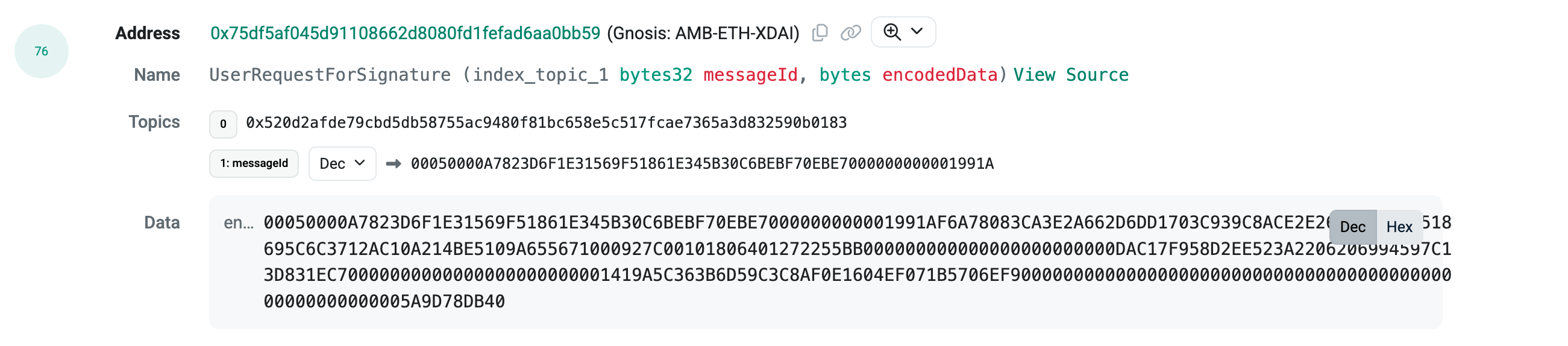
- Go to AMB Helper contract on Gnosis Chain, paste the
encodedDatafromUserReqeustForSignatureintogetSignatures(bytes _message)(the message starts with 0x0005). Fetch the return value fromgetSignatures.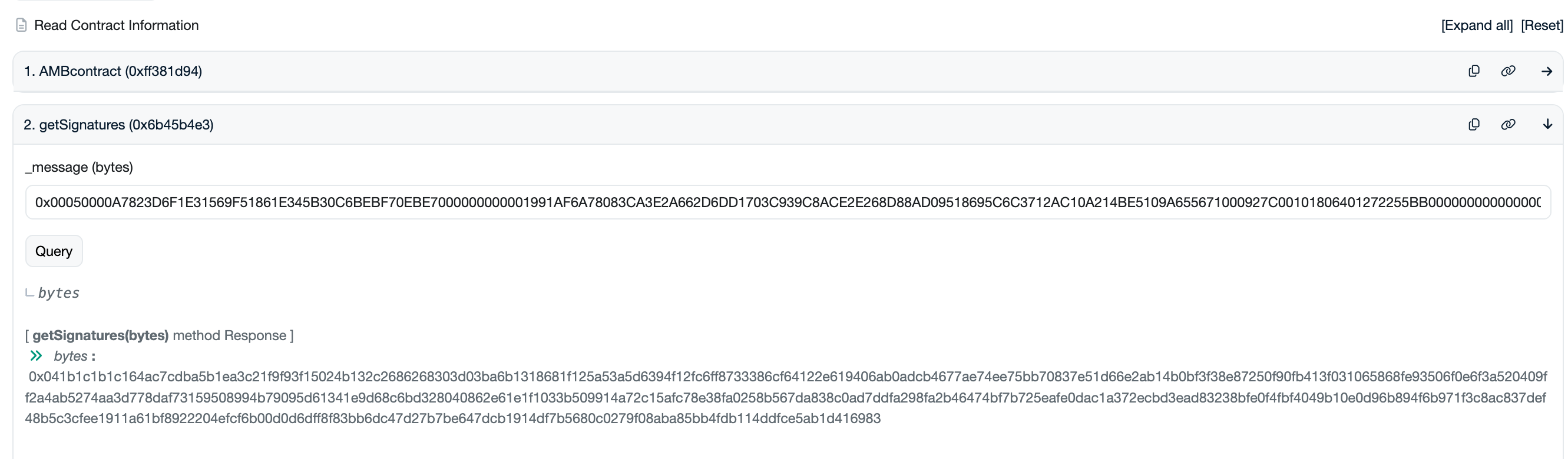
- On Foreign AMB, call
executeSigantures(bytes _data, bytes _signatures), where_datais theencodedDatafromUserRequestForSignatureand_signaturesis from the return value ofgetSignaturesmethod. Please make sure that the caller account has enough ETH for the gas fee.
How to check if AMB is down (not relaying message)
In certain circumstances, i.e. hardfork, AMB will be planned for downtime (not relaying message) to ensure security of the bridge. Planned downtime will be announced in public channel like Discord and Twitter, prior to the event.
There is also another way to check whether the AMB is down or not by reading maxGasPerTx value on AMB contract.
In the current configuration, maxGasPerTx is set to 4000000 on Ethereum and 2000000 on Gnosis Chain.
The AMB is down when maxGasPerTx is set to 0, only by owner of the contract.
By setting maxGasPerTx to 0, the condition in _sendMessage() will not pass, meaning, the bridge is down/stopped.
Legacy components on the bridge contracts
-
Hashi: Hashi componetns was integrated into the bridge, but was deprecated. The on-chain contract still remains but don't affect the transaction verification logic. Please check here for more details.
-
GSN: OpenGSN (Ethereum Gas Stations Network) is not in used but remains in the contracts.
-
AsyncInformationProcessor: Not supported by bridge validators.
Security Considerations for Receiving a Call
| Concern | Remediation |
|---|---|
| Authorization | Check the address of invoking contract using messageSender() |
| Authorization | Check that msg.sender is the address of the bridge contract |
| Replay Attack | transactionHash() allows for checking of a hash of the transaction that invoked the requireToPassMessage() call. The invoking contract (in some cases, the mediator contract) is responsible for providing a unique sequence (can be a nonce) as part of the _data param in the requireToPassMessage() function call |
AMB Components
| Component | Description |
|---|---|
| System Contracts | AMB Implementation Contracts (Home Bridge and Foreign Bridge), Governance Multisigs, gas limit helpers, failed call management helpers (for when gas estimate was insufficient), and fee management helpers to collect fees |
| Bridge validator | Containerized microservices that listen for on-chain events and send confirmations to relay messages. More on them here. |
| DevOps | Bridge validator,Bridge UI, docker compose, ansible playbooks |
| dApp Contracts | extensions (pair mediator contracts on both sides of the AMB), such as the Omnibridge |
Use Cases of AMB
- ERC-to-ERC Bridges:
AMB-ERC-TO-ERCmode enables the transfer of ERC tokens to the Foreign Mediator, which will interact with Foreign AMB Bridge to mint wrapped ERC-667 tokens on the Home Network. Complimentarily, the mode enables the transfer ERC20 or ERC-667 tokens to the Home Mediator, which will interact with Home AMB Bridge to unlock ERC20 tokens on the Foreign network. This is used by the Omnibridge. - ERC-to-Native Bridges:
ERC-TO-NATIVEmode enables the user to send ERC20 tokens to the Foreign Bridge and receive native coins from the Home Bridge Complimentarily, then can send native coins to the Home Bridge to unlock ERC20 tokens from the Foreign Bridge. The home network nodes must support a consensus engine that allows using a smart contract for block reward calculation. This mode is used by the xDai Bridge - Message Passing:
ARBITRARY-MESSAGEmode enables the capability to invoke a Home/Foreign Bridge contract to send a message that will be executed on the other Network. This can be an arbitrary contract method invocation.